
Why I chose abstract painting: a path to freedom, imagination and colour
I started painting at a very young age. For many years, right up until 2019, I devoted myself mainly to landscapes and still lifes.
I loved observing nature, capturing it on canvas, painting everyday objects, seeking out beautiful light and creating balanced compositions. This period was crucial to my development and enabled me to acquire the foundations that still serve me well today.
Then, gradually, something changed.
I felt the need to paint differently. No longer just what I saw, but what I felt.
This need did not arise overnight. It developed through my reading, my research into art history and my discoveries of artists who have profoundly shaped the way I view painting.
An encounter with abstraction
The books I read during that period did not turn me into an abstract painter. Above all, they put into words a development that I had already sensed intuitively.
In “On Modern Art”, Paul Klee writes that:
« Art does not reproduce the visible; it makes visible. »
This sentence resonated deeply with me.
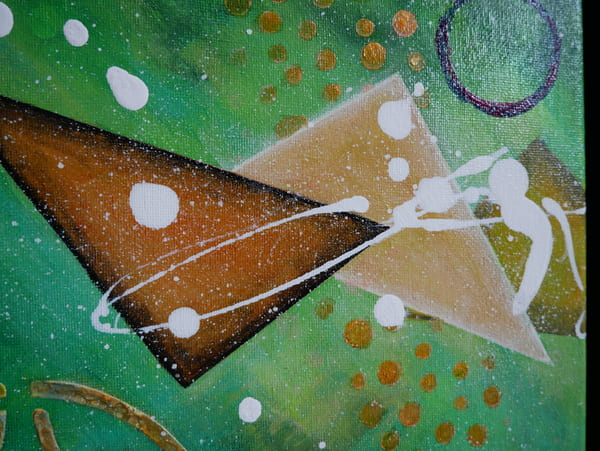
I found an essential idea in it: painting is not limited to faithfully reproducing reality. It can reveal what is not immediately visible: an emotion, an energy, a light, a sensation.
With “Functions of Painting”, Fernand Léger also led me to reflect on the role of art in the modern world. Painting is not merely a decorative object. It can shape the way we look at, feel and understand the world around us.
Reading “What is landscape?” by Michaël Jakob then furthered my reflection on the representation of landscape.
I realised that a landscape is not merely a place to be depicted. It is also a construction of the gaze, an encounter between an external space and an internal perception.
This idea resonated deeply with my own artistic journey.
I no longer seek simply to paint a landscape, but rather the memory, the emotion or the atmosphere it has left within me.
I am less interested in faithfully depicting a place than in conveying its light, its colours, its silence or a sensation that is difficult to put into words.
My landscapes thus become interpretations, personal visions in which reality gradually gives way to the imagination.
Kandinsky’s explorations into the expressive power of forms and colours have also shaped this development. They have reinforced my belief that a work of art can move the viewer without necessarily relying on a recognisable representation.
Understanding the abstract approach
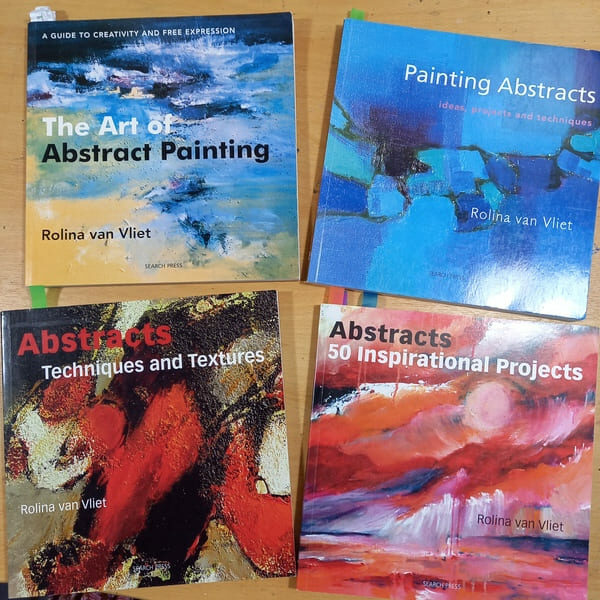
Whilst these readings enabled me to reflect on the role of art, Rolina van Vliet’s books helped me to understand the practice of abstract painting in more concrete terms.
She explains that the essential qualities of this approach are creativity, expression, originality and individuality.
These words immediately struck a chord with me.
She also points out that in abstract painting, the artist draws on their feelings, intuition and imagination.
That is precisely what appealed to me.
Abstraction demands great sincerity. It invites us to look deep within ourselves for what we wish to express.
It does not merely seek to depict the visible world.
It opens a door to an inner world.
Abstraction as a space for freedom and imagination
Today, we live in a world where images, screens and information are constantly streaming past us.
Everything is often explained, identified and interpreted before we even have time to ask ourselves questions.
I firmly believe that abstract art offers a different kind of space.
A space where the imagination can take centre stage once more.
An abstract work does not provide a single answer.
It invites everyone to form their own interpretation.
To slow down.
To observe.
To feel.
Each person can see in it a different story, a memory, an emotion or a sensation that is uniquely their own.
That is also why I chose this path.
I do not wish to impose anything on the viewer.
I like to leave a touch of mystery and offer a space where everyone can journey with their own sensibility.
Colours have become my language
This shift towards abstraction is closely linked to my relationship with colour.
During this period, I immersed myself in reading about colour, notably “The Art of Color” by Johannes Itten and “The Little Book of Colours” by Michel Pastoureau.
These books helped me to better understand harmonies and contrasts, as well as the history of colours and their influence on our perception of the world.
I realised that the colours around us are never insignificant. They reflect an era, a culture, a way of life. They influence our emotions, often without us even realising it.
In our everyday environment, neutral colour palettes now play a significant role. Cars, interior design, clothing and even architecture often favour greys, blacks, beiges or subdued tones.
I am not criticising this trend, but it reinforces my desire to champion a different vision.
Through my painting, I have chosen to restore colour to its rightful place.
Not merely as a decorative element, but as a genuine language capable of conveying emotion, energy, light or a sensation.
I love the idea that a painting can offer a breath of fresh air, a splash of colour in an everyday life that can sometimes be very monotonous.
Little by little, colours have ceased to be merely a compositional element.
They have become the true subject of my paintings.
Even today, they continue to guide every one of my creations.
Colour has become my language.
Two paths, one quest
I don’t believe we should set figurative painting against abstract painting.
Like Nicolas de Staël, I don’t set them against one another. They are two different styles, two ways of expressing an emotion.
Some of my works arise from the memory of a landscape, a light or an atmosphere. Others emerge without any identifiable starting point.
Yet their intention remains the same: to convey an emotion, to leave room for the imagination and to invite everyone to form their own perspective.
What matters to me is not choosing between the figurative and the abstract.
It is to create a painting that makes you feel more than it shows.
A matter of course
Why did I choose abstract painting?
Because it leaves room for the imagination.
Because it invites everyone to form their own perspective.
Because it puts colour back at the heart of our emotions.
Because it offers us a moment of contemplation in a world where everything seems to be moving ever faster.
I don’t paint simply to depict the world.
I paint to invite everyone to look at it in a different way.
Thank you for taking the time to learn about my artistic journey. I invite you to continue exploring this journey through my artworks and my other articles in the “Perspectives” section.